
quoteElementoDesde: 0.9.0
Muestra una cita junto con una atribución opcional.
Ejemplo
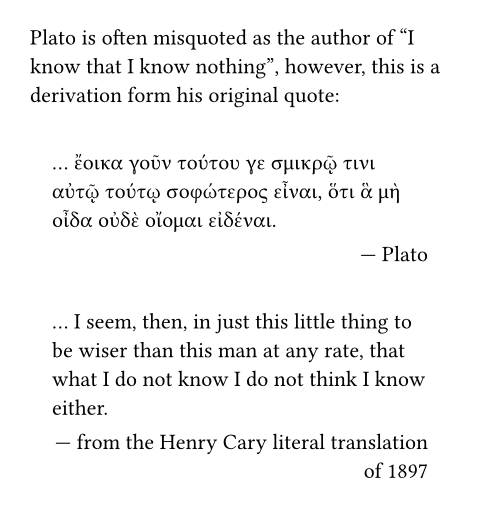
Plato is often misquoted as the author of #quote[I know that I know
nothing], however, this is a derivation form his original quote:
#set quote(block: true)
#quote(attribution: [Plato])[
... ἔοικα γοῦν τούτου γε σμικρῷ τινι αὐτῷ τούτῳ σοφώτερος εἶναι, ὅτι
ἃ μὴ οἶδα οὐδὲ οἴομαι εἰδέναι.
]
#quote(attribution: [from the Henry Cary literal translation of 1897])[
... I seem, then, in just this little thing to be wiser than this man at
any rate, that what I do not know I do not think I know either.
]
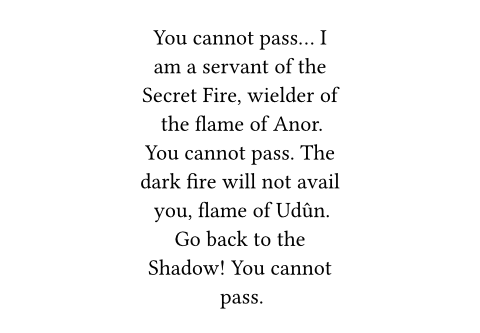
Por defecto, las citas en bloque tienen un relleno de 1em a izquierda y derecha; la alineación y el relleno se pueden controlar con reglas show:
#set quote(block: true)
#show quote: set align(center)
#show quote: set pad(x: 5em)
#quote[
You cannot pass... I am a servant of the Secret Fire, wielder of the
flame of Anor. You cannot pass. The dark fire will not avail you,
flame of Udûn. Go back to the Shadow! You cannot pass.
]
Parámetros
blockPor defecto: false
Si esta es una cita en bloque.
 Ver ejemplo
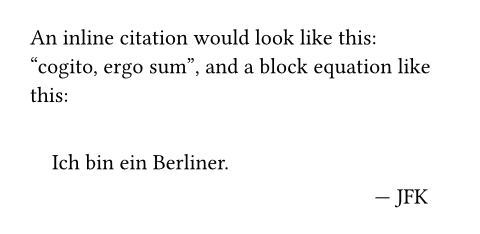
An inline citation would look like
this: #quote(
attribution: [René Descartes]
)[
cogito, ergo sum
], and a block equation like this:
#quote(
block: true,
attribution: [JFK]
)[
Ich bin ein Berliner.
]
quotesPor defecto: auto
Si se deben agregar comillas dobles alrededor de esta cita.
Las comillas dobles que se usan se infieren de la propiedad quotes de smartquote, que se ve afectada por la propiedad lang de text.
true: Envuelve esta cita entre comillas dobles.false: No envuelve esta cita entre comillas dobles.auto: Infiere si se debe envolver esta cita entre comillas dobles según la propiedadblock. Siblockesfalse, se agregan comillas dobles automáticamente.
Ver ejemplo
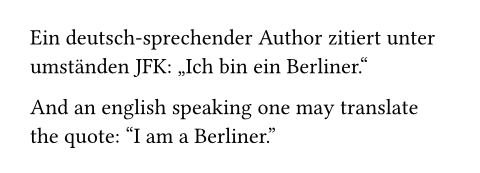
#set text(lang: "de")
Ein deutsch-sprechender Author
zitiert unter umständen JFK:
#quote[Ich bin ein Berliner.]
#set text(lang: "en")
And an english speaking one may
translate the quote:
#quote[I am a Berliner.]
attributionPor defecto: none
La atribución de esta cita, generalmente el autor o la fuente. Puede ser una etiqueta que apunte a una entrada de bibliografía o cualquier contenido. Por defecto solo se muestra para las citas en bloque, pero se puede cambiar con una regla show.
Ver ejemplo
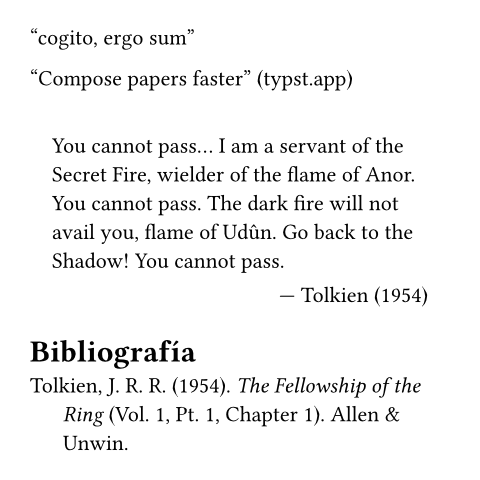
#quote(attribution: [René Descartes])[
cogito, ergo sum
]
#show quote.where(block: false): it => {
["] + h(0pt, weak: true) + it.body + h(0pt, weak: true) + ["]
if it.attribution != none [ (#it.attribution)]
}
#quote(
attribution: link("https://typst.app/home")[typst.app]
)[
Compose papers faster
]
#set quote(block: true)
#quote(attribution: <tolkien54>)[
You cannot pass... I am a servant
of the Secret Fire, wielder of the
flame of Anor. You cannot pass. The
dark fire will not avail you, flame
of Udûn. Go back to the Shadow! You
cannot pass.
]
#bibliography("works.bib", style: "apa")
body
La cita.